
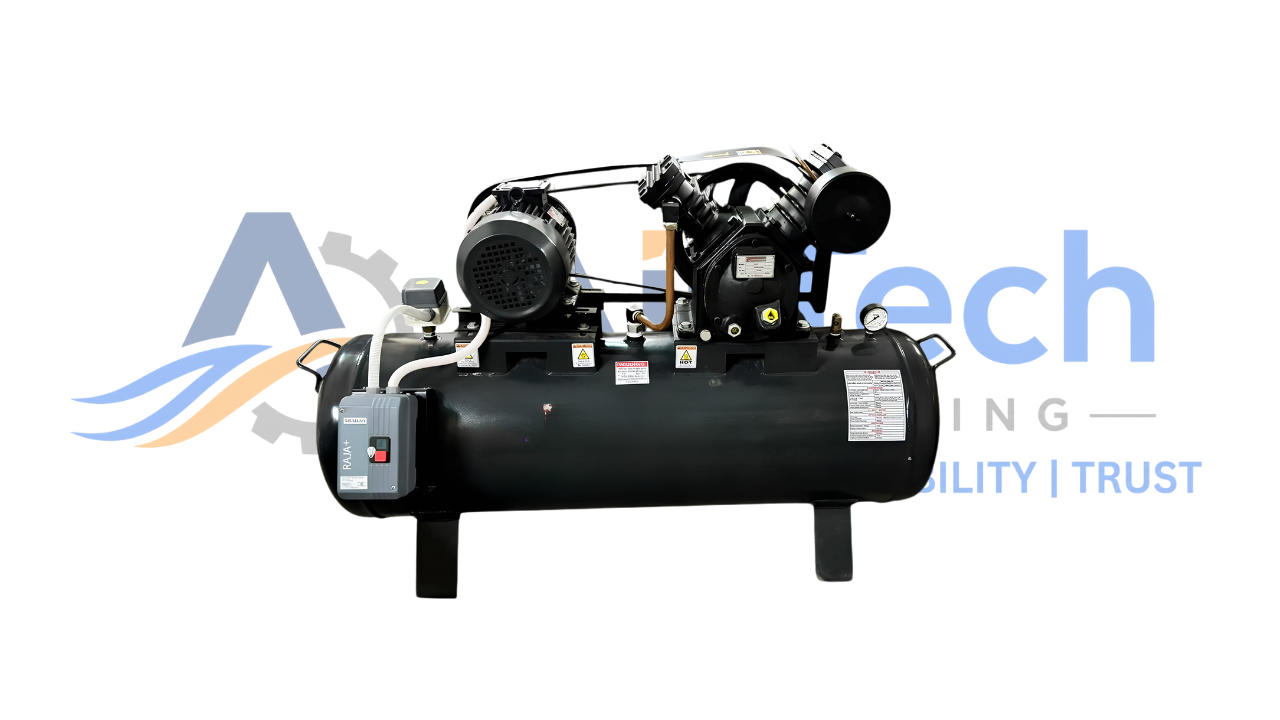
RECIPROCATING AIR COMPRESSOR
rugged piston power.
Our reciprocating (piston) air compressors are built rugged for workshops, garages and heavy industrial duty where dependable compressed air is a must. Simple to maintain and engineered for a long service life.
We supply, install and service every unit with genuine spares and 24×7 breakdown assistance, so your tools and machines never run short of air.
TIME-PROVEN PISTON
field-reliable, easy to maintain.
A reciprocating compressor works on the positive-displacement principle — a crankshaft drives pistons up and down inside cast-iron cylinders. On the down-stroke, the inlet valve opens and air is drawn into the cylinder; on the up-stroke, the inlet valve closes, air is compressed and the discharge valve opens to push high-pressure air into the receiver tank.
Single-stage units compress air in one step to 7–8 bar — ideal for workshops and general pneumatic tools. Two-stage units compress first to an intermediate pressure (~3.5 bar), cool the air in an intercooler, then compress again to 10–30 bar — giving higher output at lower running temperatures and longer component life.
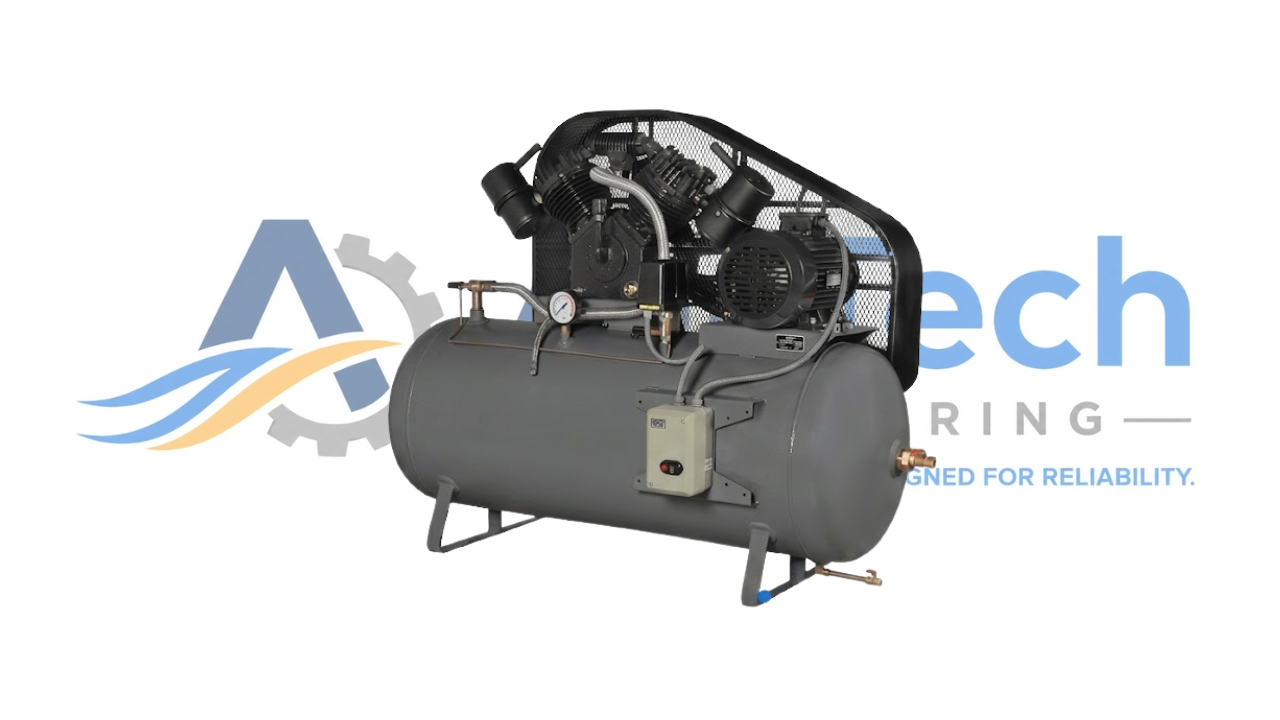
BUILT RUGGED, BUILT TO LAST
engineering you can count on.
Single & Two-Stage Compression
Single-stage for 7–8 bar workshop use; two-stage with intercooling for 10–30 bar high-pressure applications. Two-stage design reduces discharge temperature by up to 120°C compared to single-stage, extending piston ring and valve life significantly.
Heavy-Duty Cast Iron Construction
Cylinders, valve plates, crankcase and crossheads are machined from close-grain cast iron for high wear resistance and dimensional stability. Hardened crankshaft runs in replaceable shell bearings for easy overhaul without replacing the entire crankcase.
Splash / Force-Feed Lubrication
Small units use an oil-splash system with big-end dippers; larger units use a gear-driven oil pump for positive pressure lubrication of all main and big-end bearings. Oil pressure switch trips the motor if oil pressure drops, preventing catastrophic seizure.
Low-Speed Operation
Runs at 700–960 RPM via V-belt and flywheel — far slower than high-speed imported alternatives running at 1450+ RPM. Slower speed means cooler cylinder heads, longer piston ring life, quieter operation and reduced vibration on the foundation.
Reliable Valve System
Stainless-steel reed or plate valves with a precisely controlled valve lift ensure crisp opening and closing at every stroke. Valves are the most wear-prone item; our design allows field replacement in under 30 minutes without removing the cylinder from the frame.
Easy Field Maintenance
All service items — oil drain, inlet filter, valve plates, piston rings, unloader valve — are accessible from the front without disconnecting pipework. Standardised fasteners mean no special tools are required. Genuine spare kits are stocked locally for next-day delivery.
TECHNICAL SPECIFICATIONS
the numbers that matter.
| Parameter | Single Stage | Two Stage |
|---|---|---|
| Power Range | 1 – 10 HP | 5 – 20 HP |
| Capacity | 3 – 45 CFM | 20 – 100 CFM |
| Working Pressure | 7 – 8 bar | 10 – 30 bar |
| Operating Speed | 1,000 – 1,450 RPM | 700 – 960 RPM |
| Cylinder Material | Close-grain cast iron (honed bore) | |
| Lubrication | Splash system | Force-feed (gear pump) |
| Duty Cycle | Up to 70% | Up to 60% |
| Cooling Method | Air-cooled (fin & tube cylinder head) | |
| Noise Level | 72 – 78 dB(A) | 70 – 76 dB(A) |
| Motor Type | IE2 / IE3 induction motor (single or three phase) | |
| Drive | V-belt & flywheel (adjustable tension) | |
| Voltage / Phase | 230 V / 1-Ph or 415 V / 3-Ph | 415 V / 3-Phase / 50 Hz |